How do they work?
A Redox Flow Battery (RFB) is a type of rechargeable battery that stores energy in two separate liquid electrolyte solutions which circulate through a membrane-divided system to generate electricity through redox reactions.
The Vanadium Redox Flow Battery uses a fireproof vanadium-based fluid electrolyte with a 20,000 (54 year) lifespan. Use of this electrolyte allows easy maintenance, repair and system expandability. Vanadium is a metal with a high electrical density and the unique ability to reach four different oxidation levels – V2, V3, V4 and V5 – which makes it the ideal choice.
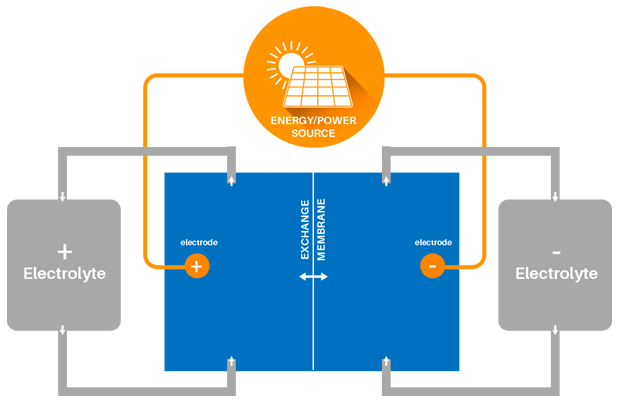
A Vanadium Redox Flow Battery (VRFB) is made up of two tanks filled with electrolyte fluid and a cell stack. The cell stack is comprised of battery cells. The number and size of the cells determines the power output. Each of these cells is divided into two chambers separated by an ion membrane (exchange membrane). In each chamber there is a positive or a negative electrode.
Of the two tanks, one contains a positive electrolyte fluid (cathode) and one contains a negative electrolyte fluid (anode). Both electrolytes consist of vanadium dissolved in sulphuric acid, but one tank contains negative electrons and a reduced oxidation level and the other tank contains positive electrons and an increased oxidation level.
To charge or discharge the battery, the electrolyte is pumped through the cell stack. Two separate flow systems exist. Two different electrolyte solutions are pumped from the tanks through the cell, on either side of the membrane. The ion membrane (exchange membrane) allows electrons to pass through without the mixing of the two electrolytes. A chemical to electrical energy transformation takes place.
As soon as an electrical load is applied to the stack, the electrochemical reaction begins: the current flows and the charge is removed from the electrolyte. To recharge the electrolytes, an external voltage is applied so that the reaction is reversed.
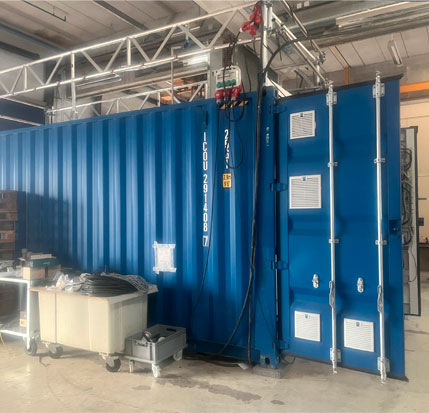
Container holding a VRFB for larger systems.

Charge controller boxes
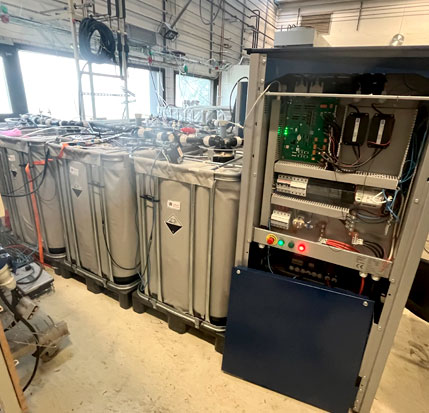
Tanks and Control Rack for Model 10 systems

Control Racks - ‘the brain and heart of the unit’.

Research and testing
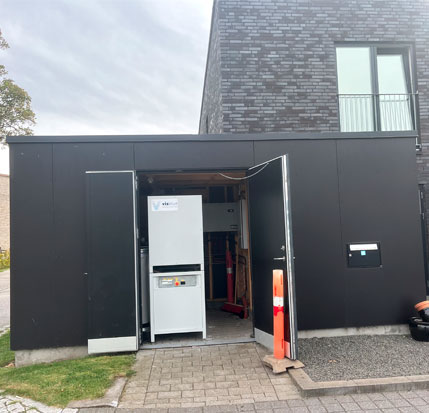
Use of VRFBs in a housing association, Denmark